Prospectus
Welcome to Rainbow Pre-school, we have prepared this prospectus so that all parents/carers are aware of what we try to achieve at the pre-school and are given the relevant information to assist us in achieving this.
Our pre-school lead is Mrs Donna Ellis, and her deputy is Mrs Carla Dabbs. We are run by a parent elected committee and our daily running is in co-operation with them.
The Committee consists of a chair, secretary, treasurer and several general members. Like you, they are all parents with children attending the pre-school, so your children benefit from what they do behind the scenes; without the Committee Rainbow Pre-School cannot run.
The main function of the Committee is fundraising. They organise many events and activities throughout the year, and with the enormous generosity of those who participate, they have all been very successful.
Our aims are:
• To give outstanding quality care in a safe and stimulating environment in which pre-school aged children can attain their full potential by developing as individuals.
To work within a framework which ensures equality of opportunity for all children and families.
Our offer for your child:
• A specially tailored curriculum for pre-school children, leading to approved learning outcomes.
• Individual care and attention made possible by a high ratio of adults to children, currently 1:5 for under 3’s and 1:8 for 3 and 4 year olds.
• Fun and friendship with children and other adults.
• The support of a personal keyperson.
• Opportunities for you and your family to be directly involved in the activities within the pre-school and your child’s progress.
Our pre-school meets Monday to Friday 9.00 to 12.00pm and 11.55 to 3.00pm, during term time, (dates available separately). Our setting offers education and care for children from the term in which children turn 2½ years up to school age.
We hope that your child’s time in pre-school will be a very happy and productive one. If you have any queries or if we can be of any help, please contact the staff or committee at any time.
Staffing
We are proud of the high ratio of adults to children in our setting, as it ensures individual attention for the needs and development of each child.
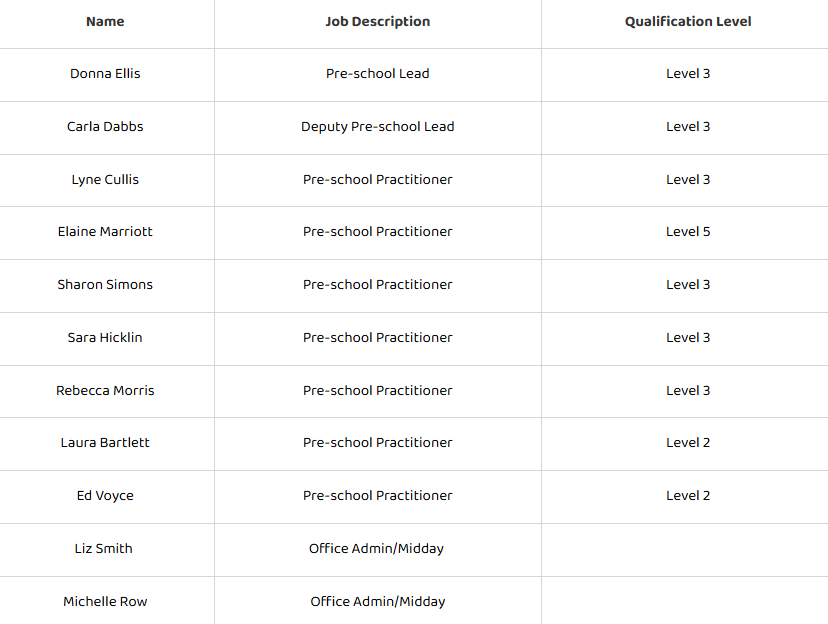
We have 12 members of staff in our employ who work on various days of the week. According to demand, or in exceptional circumstances, we operate with a minimum of 6 adults per session for a maximum of 32 children. All staff have undertaken pre-school learning courses and 9 are qualified to run a pre-school. Several of our staff are also qualified in Makaton (sign and say), Talkboost, Elklan, first aid (at least 1 per session), child observation, special needs and food hygiene. We also employ 2 members of staff as administrators.
Name | Job Description | Qualification Level |
Donna Ellis | Pre-school Lead | Level 3 |
Carla Dabbs | Deputy Pre-school Lead | Level 3 |
Lyne Cullis | Pre-school Practitioner | Level 3 |
Elaine Marriott | Pre-school Practitioner | Level 5 |
Sharon Simons | Pre-school Practitioner | Level 3 |
Sara Hicklin | Pre-school Practitioner | Level 3 |
Laura Bartlett | Pre-school Practitioner | Level 2 |
Ed Voyce | Pre-school Practitioner | Level 2 |
Liz Smith | Office Admin/Midday | |
Michelle Row | Office Admin/Midday |
If you are unable to see the table above please see the pdf version here
Our keyperson system gives each member of staff particular responsibility for a group of children so that each child in the group has at least one special adult to relate to; we find this can make settling into the setting easier for the child. In addition, the keyperson is in a position to tailor the curriculum to the unique needs of each individual child. A keyperson will normally be assigned to your child at their first session.
Some of the children’s project work is stored in a folder designated for your child at pre-school along with the keyperson’s observation notes; this ensures that a record of achievements and progress is held. Parents are free to access these or to talk to their child’s keyperson at any time. We encourage ongoing discussions throughout your child’s time at Rainbow and annually at the Annual General Meeting. Your child’s folder is released to parents/guardians at the end of the child’s time at pre-school.
THE CURRICULUM
As part of Rainbow’s registration requirements, we work in line with the standards set out in the Early Years Foundation Stage (EYFS) document. Through four overriding principles (a Unique Child, Positive Relationships, Enabling Environments, and Learning and Development) we ensure that each child is treated as an individual and is secure, confident, and happy to learn through play, progressing at their own pace.
The characteristics of effective learning and the prime and specific areas of learning and development are all interconnected.
The ways in which a child engages with other people and their environment (playing and exploring, active learning and thinking critically) underpin learning and development across all areas. These support the child to remain an effective and motivated learner.
The Prime Areas of Learning
These three areas are particularly important for building a foundation, igniting children’s curiosity and enthusiasm for learning, forming relationships, and thriving.
Personal, social, and emotional
Development is crucial for children to lead healthy and happy lives. Strong, warm and supportive relationships with adults enable children to learn how to understand their own feelings and those of others. Children should be supported to manage emotions, develop a positive sense of self, set themselves simple goals, have confidence in their own abilities, persist and wait for what they want, and direct attention as necessary. Through adult modelling and guidance, children will learn how to look after their bodies, including healthy eating, and managing their personal needs independently. Through supported interaction with other children, they learn how to make good friendships, to co-operate, and to resolve conflicts calmly. These attributes provide a secure platform from which children can achieve at school and in later life.
Communication and Language
The development of children’s spoken language underpins all seven areas of learning and development. Children’s back-and-forth interactions from an early age form the foundations for language and cognitive development. The number and quality of the conversations they have with adults and peers throughout the day in a language-rich environment is crucial. By commenting on what children are interested in or doing and echoing back what they say with new vocabulary added, practitioners will build children’s language effectively. Reading frequently to children and engaging them actively in stories, non-fiction, rhymes and poems, and then providing them with extensive opportunities to use the embed new words in a range of contexts, will give children the opportunity to thrive. Through support and modelling from their keyperson and sensitive questioning that invites them to elaborate, children become comfortable using a rich range of vocabulary and language structures.
Physical Development
We provide opportunities for children to play both indoors and outdoors, supporting them in developing their core strengths, stability, balance, spatial awareness, co-ordination, and agility. Gross motor skills provide the foundation for developing healthy bodies as well as social and emotional well-being. Fine motor control and precision helps with hand-eye co-ordination, which is later linked to early literacy. Repeated and varied opportunities to explore and play with smallworld activities, puzzles, arts and crafts, and using small tools, with feedback and support from adults, allow children to develop proficiency, control and confidence.
The specific areas of learning
These grow out of the prime areas and include essential skills and knowledge for children to participate successfully in society.
Literacy
It is crucial for children to develop a life-long love of reading. Reading consists of two dimensions: language comprehension and word reading. Language comprehension (necessary for both reading and writing) starts from birth. It only develops when adults talk with children about the world around them and the books (stories and non-fiction) they read with them, including enjoy rhymes, 4 poems and songs together. Skilled word reading, which is taught later, involves both the speedy working out of the pronunciation of unfamiliar printed words (decoding), and the speedy recognition of familiar printed words; writing involves transcription (spelling and handwriting), and composition (articulating ideas and structuring them in speech before writing).
Mathematics
We provide opportunities for children to develop the necessary building blocks to excel mathematically. Activities promote counting, understanding and using numbers, calculating, problem solving as well as shapes, space, and measures. It is important that children develop positive attitudes and interests in mathematics, look for patterns and relationships, spot connections, “have a go”, talk to adults and peers about what they notice and not be afraid to make mistakes.
Understanding the World
We provide opportunities for children to explore, find out about people, places, technology, and the environment in order for them to make sense of their physical world and community. A broad selection of stories, non-fiction, rhymes and poems help them to understand our culturally, socially, technologically and ecologically diverse world. The frequency and range of children’s personal experiences increases their knowledge and sense of the world around them.
Expressive Arts and Design
Through art, music, movement, dance, role play and design and technology we encourage children to explore and play with a wide range of media and materials while providing opportunities for them to share their thoughts, ideas and feelings through a variety of activities. The frequency, repetition and depth of their experiences are fundamental to their progress in interpreting and appreciating what they hear, respond to and observe.
The Role of Parents:
Rainbow Pre-school recognises parents as the first and most important educators of their young children and aims to support them. These are some examples of how this can be done.
1. Take part in fundraising.
2. Participate in the management of the pre-school by joining our committee.
3. Read the information board page which is displayed outside the main door or read our Facebook; this gives you lots of talking points to share with your child about their day.
4. Informal chats with your keyperson or other members of staff.
5. Regular meetings with your keyperson to look at your child’s “special folder”.
6. Label all removable clothing and belongings, and encourage your child/ren to help themselves, i.e. toilet, noses, putting on coats/shoes.
PRE-SCHOOL POLICIES
Rainbow Pre-school have defined their policies on a number of issues relating to pre-school children, these are held at the pre-school for general inspection. These policies are reviewed on a regular basis, comments and suggestions from parents are always welcome.
The most important of these policies are summarised below:
Confidentiality
It is our intention to respect the privacy of children, their parents, and carers while ensuring that they access high quality early years care and education in our setting. We aim to ensure all parents and carers can share their information in the confidence that it will only be used to enhance the welfare of their children.
We keep two kinds of records on children attending our setting:
1. Developmental records – observations, photographs, samples of work, summary developmental reports, and records of achievement.
2. Personal records- registration and admission forms, signed consents, correspondence concerning the child or family, reports or minutes from meetings concerning the child from other agencies, an ongoing record of relevant contact with parents and observations by staff on any confidential matter involving the child, such as developmental concerns or child protection matters.
There are record keeping systems in place that meet legal requirements; the means of storing and sharing information takes place within the framework of the General Data Protection Regulations (2018) and the Human Rights Act (1998).
Parents have access, in accordance with the access to records procedure, to the files and records of their own children but do not have access to information about any other child. Staff will not discuss personal information given by parents with other members of staff except where it affects planning for the child’s needs.
We work closely with the local primary schools to ensure a smooth transition from pre-school. This may involve sharing children’s developmental records.
Promoting Inclusion, Equality and Valuing Diversity
Our Pre-school is committed to valuing diversity by providing equality of opportunity and anti-discriminatory practice for all children and families.
The pre-school recognises that different types of family groups can, and do, successfully love and care for children. The pre-school aims to offer support to all families.
Our aim is to show respectful awareness of all major events in the lives of the children and their families in the pre-school, and in our society, and we welcome the diversity of backgrounds from which they come.
Appropriate opportunities will be given to children to explore, acknowledge and value similarities and differences between themselves and others.
Any discriminatory language, behaviour or remarks by children, parents or any other adults are unacceptable in the pre-school.
The pre-school will make every effort to ensure that the time, place and conduct of meetings enable most parents to attend so that all families have an equal opportunity to be involved in and informed about the pre-school.
British Values
The fundamental British values of democracy, rule of law, individual liberty, mutual respect and tolerance for those with different faiths and beliefs are already implicitly embedded in the 2023 EYFS.
The Early Years Foundation Stage (EYFS) supports children’s earliest skills so that they can become social citizens in an age-appropriate way, that is, so that they are able to listen and attend to instructions; know the difference between right and wrong; recognise similarities and differences between themselves and others; make and maintain friendships; develop empathy and consideration of other people; take turns in play and conversation; avoid risk and take notice of rules and boundaries; learn not to hurt/upset other people with words and actions; understand the consequences of hurtful/discriminatory behaviour.
Prevent Duty
Under the Counterterrorism and Security Act 2015 we also have a duty “to have regard to the need to prevent people from being drawn into harm and radicalisation”.
Student Placement
Rainbow recognises that qualifications and training make an important contribution to the quality of care and education provided by early years settings. As part of our commitment to quality, we offer placements to students undertaking early years qualifications and training.
We require students to meet the “suitable person” requirements of the Early Years Foundation Stage, and for schools or colleges placing students under the age of 17 years to vouch for their good character. Students under the age of 17 years are always supervised and are not permitted to have unsupervised access to children.
We require students to keep to our confidentiality policy and we make the needs of the children paramount by not admitting students in numbers that hinder the essential work of the setting. We also ensure that trainees and students placed with us are engaged in Bonafide early years training which provides the necessary background understanding of children’s development and activities.
Supporting Children with Special Educational Needs and Disabilities
Named SENDCo – Donna Ellis
We provide a fully accessible environment in which all children are supported to reach their full potential.
Our pre-school aims to have regard to the DofE Code of Practice on the identification and assessment of special educational needs, and to provide a welcome and appropriate learning opportunity for all children.
At Rainbow Pre-school our Special Educational Needs and Disabilities Co-Ordinator together with our Pre-school Lead will be the main contacts for all health professionals coming into the pre-school.
Assessment of individual children will remain the responsibility of that child’s keyperson who will liaise closely with the SENDCo. This will initially be a system of 9 recorded observations together with advice and assistance from outside agencies, (i.e. their Health Visitor, Inclusion Partner).
These assessments will be shared with the parent/carer.
For further information regarding “The Local Offer” please refer to our website www.rainbowpre-school.com
Health and Safety
Named Officer – Liz Smith & Michelle Row
Rainbow believes that the health and safety of children is of paramount importance. We make our setting a safe and healthy place for children, parents, staff and volunteers.
OFSTED
Rainbow is registered with Ofsted (No: 402297) and is inspected regularly. Our last inspection was carried out in October 2024 when we were rated as “Good”. Details of our last report can be found at www.ofsted.gov.uk/reports
Quotes from the Report
“Parents speak highly about staff and the confidence they have in them. They appreciate how approachable and caring the staff are.”
“Children arrive with an abundance of confidence due to the warm welcome they receive from staff as they enter the setting.”
“Children are happy within the setting and go on to school ready for the next stage in their learning.”
No Smoking/Vaping
We comply with health and safety regulations and the Welfare Requirements of the EYFS in making our setting a no smoking and vaping environment – both indoor and outdoor.
Food and Drink
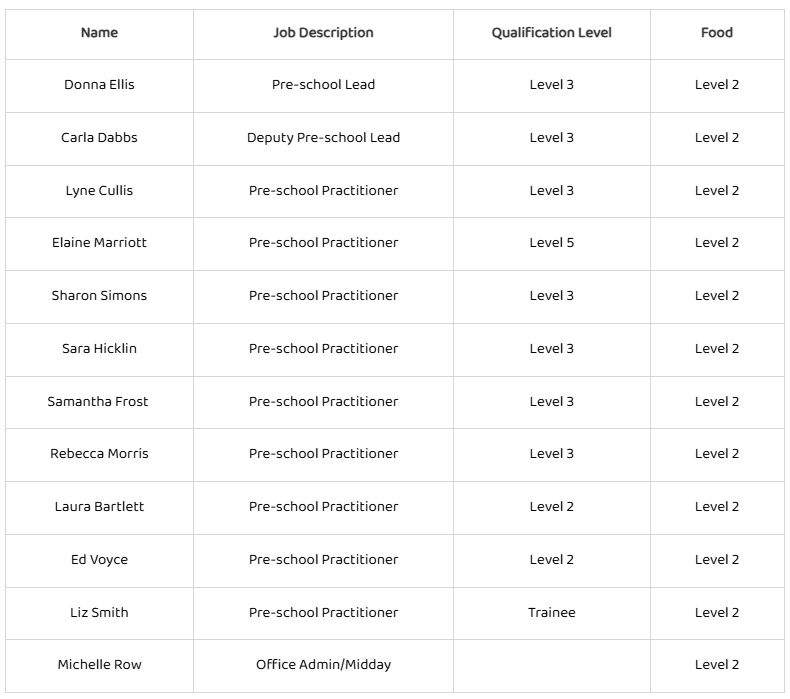
Rainbow regards snack times as an important part of the setting’s session. Eating represents a social time for children and adults and helps children to learn about healthy eating.
At snack times, we aim to provide a variety of fruit and vegetables, which meet the children’s individual dietary needs. Every month we ask for a voluntary contribution to help with the cost of providing a healthy snack. Should you wish to provide your own snack, please speak to the pre-school lead and you will be provided with our snack schedule for the week.
Name | Job Description | Qualification Level | Food |
Donna Ellis | Pre-school Lead | Level 3 | Level 2 |
Carla Dabbs | Deputy Pre-school Lead | Level 3 | Level 2 |
Lyne Cullis | Pre-school Practitioner | Level 3 | Level 2 |
Elaine Marriott | Pre-school Practitioner | Level 5 | Level 2 |
Sharon Simons | Pre-school Practitioner | Level 3 | Level 2 |
Sara Hicklin | Pre-school Practitioner | Level 3 | Level 2 |
Samantha Frost | Pre-school Practitioner | Level 3 | Level 2 |
Laura Bartlett | Pre-school Practitioner | Level 2 | Level 2 |
Ed Voyce | Pre-school Practitioner | Level 2 | Level 2 |
Liz Smith | Pre-school Practitioner | Trainee | Level 2 |
Michelle Row | Office Admin/Midday | Level 2 |
If you are unable to see the table above please see the pdf version here
Lunch
Our lunch runs from 12 noon to 12.30pm each day for all children accessing a full day or afternoon session. It is staffed by qualified practitioners with food hygiene and paediatric first aid qualifications and is overseen by the Pre-school Lead and our office staff.
Lunch should be provided by the parent/carer in suitable named containers with ice packs and any cutlery if needed. We can provide water to drink.
Rainbow operates a “NO NUTS” policy, and children will be actively discouraged from sharing their food with others which is particularly important for those children who have specific food allergies.
For ideas of what to put in your child’s lunch box we suggest a visit to www.nhs.uk/change4life/recipes/healthier-lunchboxes
For more information, please refer to our Lunch Club Policy and guidance notes which are included in your Welcome Pack.
Absence
Parents are requested to telephone the setting within one hour of the time their child would have been expected on every day of absence to inform us of the reason for non-attendance and to keep us updated on their child’s health.
In line with our Safeguarding Policy, we are prepared to act if we have concerns about the welfare of a child who fails to arrive at a session when expected. The designated person will take immediate action to contact the child’s parent to seek an explanation for the child’s absence and assurance that the child is safe and well. If no contact is made with the child’s parents, and the designated person has reason to believe the child is at risk of significant harm, the relevant professionals will be contacted immediately and LSCB procedures will be followed. If the child has current involvement with social care, the social worker will be notified on the day of the unexplained absence.
Illness
Parents are requested to keep their children away if they are suffering with Mumps, Measles, Chicken Pox or any other serious infectious disease and to be guided by their GP before returning. Should your child have conjunctivitis they may return to pre-school 24 hours after treatment has started. Furthermore, parents are requested not to bring into pre-school any child who has been vomiting or had diarrhoea until 48 hours has elapsed since the last attack. Children who have been prescribed medication cannot return to pre-school until 48 hours after first administration to ensure that there are no side effects. Rainbow will assist in this only if the relevant permission forms have been completed.
In the event your child is sent home from pre-school when they are unwell, please refrain from returning your child for at least 48 hours to avoid us having to recall you should they relapse.
Rainbow Pre-school will refuse admission to any child who has had Calpol, or similar medication administered prior to their arrival at the setting.
Admissions
It is our intention to make pre-school accessible to children and families from all sections of the local community providing a minimum of 2 sessions per week and offering up to 10 sessions if places are available.
Sessions will be offered based on the following criteria:
Date of birth, date of entry onto the waiting list, completed paperwork, available sessions, and supply of copy birth certificate and proof of address.
Achieving Positive Behaviour
Named Officer: Elaine Marriott
We believe that children flourish best when their personal, social, and emotional needs are met, and where there are clear and developmentally appropriate expectations for their behaviour (a high number of staff have been trained in this field).
Strategies with children who engage in inconsiderate behaviour
We require all staff, volunteers and students to use positive strategies for handling any inconsiderate behaviour; by helping children find solutions in ways which are appropriate for their ages and stages of development.
Children under 3 years
When children under 3 years behave in inconsiderate ways, we recognise that strategies for supporting them will need to be developmentally appropriate and differ from those for older children. We recognise that very young children are unable to regulate their own emotions such as fear, anger or distress, and require sensitive adults to help them do this.
We never send children out of the room by themselves. We believe that children and adults flourish best in an ordered environment where everyone knows what is expected of them and children are free to develop their play and learning without fear of being hurt or hindered by anyone else. We aim to work towards a situation where children can develop self-discipline and self-esteem in an atmosphere of mutual respect and encouragement.
Complaints Procedure
A parent who is uneasy about any aspect of the groups provision should first talk over any worries and anxieties with the Pre-school Lead, or their child’s keyperson. If this does not produce a satisfactory outcome, or if the problem persists, the parent should put the complaint in writing to the Pre-school Lead and the Chair of the Committee. For parents who are not comfortable with making written complaints, there is a template form for recording complaints which can be completed with the person in charge and signed by the parent.
If the parent is not satisfied with the outcome of the investigation, he or she can request a meeting with the Pre-school Lead and the Chair of the Committee. The parent should have a friend or partner present, and the Pre-school Lead should have the support of the Chair of the Committee or a senior member of the Committee present.
If an agreement cannot be made an external mediator is invited to help settle the complaint. This person should be acceptable to both parties, listen to both sides and offer unbiased advice. A mediator has no legal powers but can help to define the problem, review the action so far, and suggest further ways in which it might be resolved.
The role of the Office for Standards in Education (OFSTED), Children’s Services and Skills, the Local Safeguarding Children Board, and the Information Commissioner’s Office.
Parents may approach Ofsted directly at any stage of this complaint’s procedure. In addition, where there seems to be a possible breach of the setting’s registration requirements, it is essential to involve Ofsted as the registering and inspection body with a duty to ensure that the Statutory Framework of the Early Years Foundation Stage is adhered to.
The address and telephone number of our Ofsted regional centre is:
OFSTED National Business Unit, Piccadilly Gate, Store Street, Manchester M1 2WD Telephone No: 0300 123 1231
If a child appears to be at risk, we follow the procedures of the Local Safeguarding Children Board. In these cases, both the parent and our setting are informed, and our Pre-school Lead will work with Ofsted or the Local Safeguarding Children Board to ensure a proper investigation of the complaint, followed by appropriate action.
The Information Commissioner’s Office (ICO) can be contacted if you have made a complaint about the way your data is being handled and remain dissatisfied after raising your concern with us. For further information about how we handle your data, please refer to the Privacy Notice given to you when you registered your 14 child at our setting. The ICO can be contacted at: Information Commissioner’s Office, Wycliffe House, Water Lane, Wilmslow, Cheshire, SK9 5AF or ico.org.uk.
A record of complaints against our setting and/or the children and/or the adults working in our setting is kept, including the date, the circumstances of the complaint and how the complaint was managed. The outcome of all complaints is recorded in the Complaints Summary Record which is available for parents and Ofsted inspectors on request.
We believe that most complaints are made constructively and can be sorted out at an early stage. We also believe that it is in the best interests of the pre-school and parents that complaints should be taken seriously and dealt with fairly and in a way which respects confidentiality.
Safeguarding Children, Young People and Vulnerable Adults
Named Designated Officer – Committee Chair
Named Designated Lead – Donna Ellis
Named Designated Deputy – Carla Dabbs
Our pre-school will work with children, parents and the community to ensure the safety of children to give them the very best start in life. Any suspicion of abuse will be promptly and appropriately responded to.
Staffing and Volunteering
Applicants for posts within the setting are clearly informed that the positions are exempt from the Rehabilitation of Offenders Act 1974. Candidates are informed of the need to carry out “Enhanced Disclosure” checks with the Disclosure and Barring Service before posts can be confirmed.
We abide by Ofsted requirements to ensure that no disqualified person, or unsuitable person, works at the setting or has access to the children. Volunteers do not work unsupervised. All visitors to the setting are required to sign the visitor’s book. We take all necessary security steps to ensure that we have control over who comes into the setting.
Respond Appropriately to Suspicions of Abuse
We acknowledge that abuse of children can take different forms – physical, emotional, and sexual as well as neglect. This may be demonstrated through the things they say, changes in their appearance, their behaviour, or their play. Where such evidence is apparent, the child’s keyperson will make a dated record of the details of concern and discusses what the next steps are with the Pre school Lead.
All such suspicions and investigations will be kept confidential, shared only with those who need to know. The people most involved will be the keyperson, the Pre-school Lead and the Committee Chair.
Parents are normally the first point of contact, however, if a suspicion of abuse is recorded, parents are informed at the same time as the report is made, except where the guidance of the Local Safeguarding Children’s Board does not allow this.
Support to Families
The pre-school believes in building trusting and supportive relationships with families, staff, and volunteers. We follow the Child Protection Plan as set by the Social Services Department in relation to the setting’s designated role and tasks in supporting the child and the family, after any investigation.
We are obliged to share confidential information without authorisation from the person who provided it, or to whom it relates, if it is in the public interest. That is when:
• It is to prevent a crime from being committed, or to intervene where one may have been, or to prevent harm to a child or adult.
• Not sharing it could be worse than the outcome of having shared it.
Confidential records kept on a child are shared with the child’s parents, or those who have parental responsibility, in accordance with procedure, and only if appropriate under the guidance of the Local Safeguarding Children’s Board.
FEES
As of September 2025: £22.50 per session, plus a £10 voluntary contribution monthly for snack and consumables i.e., nappies, wipes, gloves, handwash, paper towels etc
Unless prior arrangement has been made with the Pre-school Lead or office staff, fees are to be paid monthly in advance. All parents will be given a ‘pay by’ date.
Any parent who has difficulty with fees, i.e. you are receiving benefits or have a change in circumstances, should speak to the Pre-school Lead so that any additional funding sources may be investigated.
Please be aware although it is a voluntary contribution for snack and consumables if you choose not to pay this you will be expected to supply the snack and consumables as per the lists attached (snack menu will be advised weekly on the window, and consumables will need to be brought in with your child for each session).
If holidays are taken during term times fees must be paid in full to keep the child’s place and cover operating costs. The same applies for illness, with the exception of stays in hospital and the following infectious diseases:- Chickenpox, Mumps, Measles, German Measles (Rubella), and Whooping Cough. In these cases an amendment will be made on the following month’s fees.
AFTER SCHOOL CLUB
From September 2025 we will be offering an After School Club which will run from 3.00pm till 3.30pm daily. This is an optional club to assist parents with work or other school pick up commitments. The cost for your child to attend After School Club is £4.00 per day they are enrolled to attend. The club fee will be included in your monthly invoice.
FUNDING
FEEE 3&4 Year Funding
The Government provide 15 hours of funding for 38 weeks representing a school year. This funding becomes available in the term after your child’s third birthday and forms will be provided by us to claim your allowance.
If your child attends more than 15 hours per week, either with us or shared with another setting, you will be asked to pay for those sessions for which we are unable to obtain funding at Rainbow’s current sessional rate.
30 Hours Extended Funding
Parents who feel they may qualify for the extended entitlement of 30 hours funding can check their eligibility via Childcare Choices at: https://www.childcarechoices.gov.uk or the Childcare Calculator at: https://www.gov.uk/childcare-calculator Those who could be eligible for Tax Free Childcare will be directed to the digital childcare service to apply.
Rainbow Pre-school offers a maximum of 30 hours per week; however, parents are welcome to complete the extended offer with another setting.
FEEE 2 Year Funding
Where spaces allow, we are registered to take those children who meet the criteria set for disadvantaged two-year funding. Parents should register with Essex Early Years via the link:
https://www.essex.gov.uk/Education-Schools/Early-Years childcare/Help%20paying%20for%20childcare/Pages/Two-year-old-Free Early-Education-ntitlement.aspx to make an application.
Assisted applications can also be made, please contact the office in order to arrange a time to complete this process.
30 Hours Funding for 2 Year Olds of Working Parents
The Government provides 30 hours of funding for 38 weeks representing a school year. This funding becomes available in the term after your child’s second birthday and forms will be provided by us to claim your allowance.
Parents who feel they may qualify for the entitlement of 30 hours funding can check their eligibility via Childcare Choices at:
https://www.childcarechoices.gov.uk or the Childcare Calculator at: https://www.gov.uk/childcare-calculator Those who could be eligible for Tax-Free Childcare will be directed to the digital childcare service to apply.
Notice Period
Please provide a minimum of 21 days’ notice to the Pre-school Lead if your child is leaving the pre-school, or if you wish to alter the number of sessions attended, so that arrangements can be made to offer their place to someone else. If the Pre-school Lead is given less than 21 days’ notice, then fees continue to be due. Failure to pay all monies due before your final day can result in an application to the Small Claims Court.
Late Collection of Children from Pre-school
When a parent/carer is late picking up their child from pre-school it means that two members of staff must stay beyond their hours to care for that child. Not only does the child become distressed, but the staff work unpaid and obviously they are not able to go about their own business.
Rainbow Pre-school operates late pick-up fines on the following basis. In the event of circumstances beyond your control, and provided we are informed before pick-up time, the first 5 minutes following the end of the session may be excused. However, beyond this we will charge £1 per minute that you are late. This enables us to compensate the qualified staff that remain with your child.
We would also point out that after a certain period of time; we are required to contact Social Services as the child is considered abandoned.
Events Necessitating Closure
In the event of any of the following exceptional circumstances, Rainbow Pre school may not be able to open, or may have to close, a daily session early.
• Adverse weather conditions
• Power failure
• Burst pipes and/or flooding
• No heating during cold weather
• No hot or running water
• Staff sickness
• Security/safety warnings e.g. fire, gas leak
• Pandemic, following advice from the Government or relevant authority
• Epidemic, following advice from the Infection Control Unit
In the case of Rainbow Pre-school being unable to open the following steps will be followed to keep parents informed of the situation.
• Notice on our website at www.rainbowpre-school.com
• Post on our Facebook page – Rainbow preschool Wickford
• www.essex.gov.uk – search emergency school closures
• Telephone/Text/WhatsApp
• Sign on the door
In the event Rainbow Pre-school must close a daily session or in the event any of the reasons for closing occur, we will endeavour to:-
• Contact all parents using current contact numbers. Please ensure that you advise us of any telephone number changes.
• Use emergency numbers if parents cannot be contacted.
• In the event we are unable to contact either the parent or emergency contact, we will follow our Uncollected Child Policy and Procedure.
Please note, due to administrative and running costs we will not be able to offer refunds.
Premises and Equipment
We are very fortunate that we occupy spacious premises set in the grounds of Wickford Memorial Park. We have 3 separate rooms at our disposal which are laid out as follows: 1) Kitchen/snack, home corner, art and craft room, 2) Malleable, construction, computer, role play 3) Sensory room. Children are encouraged to free flow between all areas inside and out.
We have an enclosed soft play and grassed area attached to the Pre-school which children have access to every day, all year round, unless severe weather conditions stop play.
Settling In/First Days
All children will be invited to an Open Day prior to joining the pre-school. You will then be given a start date. Your first session will last for one hour, this allows your child to play whilst you complete necessary paperwork with your child’s keyperson. Your child will attend on their own for the second session, which will last for two hours to allow you child time to settle in. Their third session will be for one full session of three hours.
Parents and staff work together to help the child feel confident and secure in the group. This takes longer for some children than for others, and parents should not feel worried if their child takes a while to settle. Our settling in policy is held at the pre-school, and parents will be given the opportunity to read this, along with the other policies, on their first visit.
What To Wear
In order to feel free to explore and experiment with all kinds of materials, including messy ones, it is best to send children dressed in clothes which are easily washable or not too new. It is good for children to practice the skills which will make them independent; simple clothing which they can handle themselves will enable them to go to the toilet when they want to, and to put and take off their outdoor clothes without being too dependent on other people’s help. Rainbow Pre-school t-shirts and sweatshirts are available to purchase from the office (but are not compulsory).
Our garden area is always accessible, please can we ask you to provide warm wet weather clothing, including raincoat, wellies, hat, scarf, gloves. (Please ensure these are all labelled with your child’s name)
During the summer months it would be appreciated if you would send your child to pre-school with the appropriate sunscreen applied and a sun hat. If your child is attending 2 sessions in one day, we would ask you to provide a named bottle of sunscreen (at least factor 30) so that re-application can take place. Please be advised that we would recommend Nivea Sun Babies and Kids Sensitive Protect Factor 50+ as this does not contain nut oil.
Rainbow Pre-school cannot accept responsibility for any items lost whilst on the premises.
Un-named lost property will be retained until the end of the school year when it will be displayed at the Annual General Meeting. Unclaimed items will be donated to charity.
PLEASE ENSURE EVERY REMOVABLE ITEM OF YOUR CHILD’S CLOTHING, IS LABELLED INCLUDING SHOES, BAGS AND FLASKS
POLITE REQUEST
We have several parents that bring their dogs to drop off and pick up. As much as we all love our fur babies, one of our children or families might have a severe allergy or fear of dogs, so we kindly ask that you refrain from bringing them to the Pre-school.
INFORMATION WE HOLD ABOUT YOU AND YOUR CHILD
We have procedures in place for the recording and sharing of information about you and your child that is compliant with the principles of the General Data Protection Regulations (2018) as follows:
The data we collect is:
1. Processed fairly, lawfully and in a transparent manner in relation to the data subject [you and your family].
2. Collected for specified, explicit and legitimate purposes and not further processed for other purposes incompatible with those purposes.
3. Adequate, relevant and limited to what is necessary in relation to the purposes for which data is processed.
4. Accurate and, where necessary, kept up to date.
5. Kept in a form that permits identification of data subjects [you and your family] for no longer than is necessary for the purposes for which the personal data is processed.
6. Processed in a way that ensures appropriate security of the personal data, including protection against unauthorised or unlawful processing and against accidental loss, destruction or damage, using appropriate technical or organisation measures.
When you register your child with us, we will provide you with a privacy notice that gives you further details of how we fulfil our obligations with regard to your data.
please see the link to the pdf/downloadble prosectus here.


Charity Number: 1046532 © Rainbow Pre-School 2024
Address:
Highcliffe Playcentre,
Wickford Memorial Park,
Rettendon View, Wickford
SS11 8JE